I absolutely detest this ending in which the universe is reset, thus effectively erased everything we know. All the characters in the previous Parts are replaced by alternate versions of themselves so they aren't the same characters that we know anymore. The timeline that we know is gone. Everyone IS dead and the result IS a fresh universe. This is the biggest defeat for the Joestars and their allies.
1/ You can say that "Jolyne is reborn as Irene" and "everyone from Parts 1-5 still exists as they are" but that is not the same characters that we know. This is NOT similar to the case of Dio where he just glued his head to Jonathan's body. This is a complete overwrite - an analogy is rewriting a hard disk in your computer = all your data got replaced by new data. Jolyne's group did not simply kill Pucci and be done with it; when Pucci dies, the universe is reset into a new universe where he doesn't exist. A universe where the course of events doesn't allow for Pucci's existence simply cannot be the same universe. Even IF the new timeline is 100% similar to the old one, it is still a different one. Not to mention that in this timeline, the characters have lived different lives with different relationships: 'Anasui' dating 'Jolyne', Jotaro being a good father, the gang not in prison, etc.
The Joestars are freed from Dio's curse and having completely new lives.
Also, for the Dio Curse to go away, there must be a substantial change to all events in time.
No Dio curse = no Part 3 = no friendships with Kakyoin, Polnareff, Avdol = no character development for Jotaro = Part 5 changes completely without Polnareff.
An analogy is if you created a clone of yourself before you died and the clone lived on, the clone is still NOT you. It is just a copy of you. It doesn't change the fact that YOU - the original version - had died.
2/ Memories and experiences are a large part of what makes you who you are. The character F.F. shows us that: when F.F. died, she was dead because her memories were destroyed. That's why it was important to Jolyne to keep her father's memory disc from fading away, because she knew that those memories were what made Jotaro Jotaro.
These new universe versions might have happy lives but they're strangers to us the readers. It's not a happy ending.
3/ There are other ways to free the Joestars from Dio's curse. For instance, I would like Part 6 if the author let Giorno show up and use his Gold Experience Requiem to PREVENT Pucci from resetting in the universe in the first place, then eliminate him. That would be a logical conclusion. (I'd also like Giorno to meet the other JoJos). Then Araki could have made the characters in the later Parts descendants of Jolyne or Giorno.
4/ Because of this kind of ending, I don't feel like I can enjoy the later Parts of JJBA as much because everything thereafter takes place in a different universe. Even though Part 7 is considered the best Part by many people, I'm really not a fan of it starting a new universe. I fell in love with the universe and the characters we already had, and it was special how everything was connected in one way or another. But now we leave it behind and move to new, different stories that frankly don't have the same weight.
Showing posts with label philosophy. Show all posts
Showing posts with label philosophy. Show all posts
12 August 2019

04 March 2019
Fate series: The View on Immortality
This is a combined post written by me and Ashe_Black. I agree 100% with Ashe_Black.
 In The Epic of Gilgamesh, the only reason that Gilgamesh (and mankind) didn't become immortal was that the Herb of Immortality that he had obtained was eaten by a snake. But in Fate, it was said that Gilgamesh "went back and obtained the Herb of Immortality again just for the sake of collection" but didn't use it because blah blah. Total BS and out of character for Gilgamesh! To Gilgamesh, he did not only fear death because he loved living, it was also because he wanted to observe humanity's path until its very end, so he saw death as an end to his duty as humanity's guardian. In Fate/Zero, he agreed to participate in the HGW because, in his words, Tokiomi had summoned and given him a body/a second life ("I treat him as my vassal and he supplies me with mana"), and that he later let Tokiomi be killed when Tokiomi planned to kill him. In UBW ending, we see that Gilgamesh stubbornly clings to life. It's because he hasn't fulfilled his goal or it's because he wants to see Kirei's path, etc. For whatever reason, for whatever purposes you see him cling to life, it shows that he still sees purposes in life and never wants to die. So, if Gilgamesh successfully obtained a method for immortality, he would no doubt use it! "Oh I'm over death" is an excuse to insert the "immortality isn't good" notion into the work - this is the authors' view - and not a representation of how the character should be. Gilgamesh in The Epic became more human because he had failed to achieve what he wanted, failed to overcome his human limitations. His brief sense of accomplishment and joy vanished just as quickly as he obtained it - that made him realize the full extent of his humanity, which was the final crucial step that completed him as a man and connected him with his people. The grief of Gilgamesh, the questions that death evoked and his quest for immortality resonate with every human being who has wrestled with the meaning of life in the face of death. Also in The Epic, Gilgamesh could not achieve the kind of immortality that was available to gods. Fate - by having him able to obtain immortality but turn it down by his own will - negates the whole meaning of his journey. Fictional authors have been using characters to speak their own minds, and anti-immortality is the message that Fate wants the audience to believe.
Gilgamesh, Alucard, Sun Wukong, etc. - all these characters who strive for immortality have an interesting thing in common: They all share a great fear of death. That fear alone motivated them to master great deeds. Their desire for immortality and power was also motivated by the fear of losing what they had. This is a very HUMAN desire, considering that immortality has always been humanity's greatest dream!
There's nothing "unnatural" about immortality - just as there's nothing unnatural about the advancement of Medicine and technology.
Given that life has been struggling to evolve and survive as long as possible through any means possible, reproduction is just a very poor form of immortality. If we could pass on our consciousness through our offspring akin to instinct then it would be by definition immortality.
Not only in Fate but in a lot of other fictions (like Hellsing), the anti-immortality perception is widespread. I believe that it is some authors' way of giving solace to themselves and to the human audience watching their fictions. Ultimately it's all a form of convincing oneself that one's own state is okay because there is no better alternative realistically. IF the immortality option is actually available to us, how many of us will honestly turn it down?!
As I wrote about this for Hellsing, I completely disagree with the "reject immortality for any reason" notion. Because it is anti-progress for attempting to put a stop on humans dreaming about and striving for the possibility to begin with. More of my view on Immortality
The general theme in the Fate Universe has always been that the antagonist or the "perceived villain" are the ones who seek immortality or believes immortality to be a benefit to humanity. While the protagonists have always been those who oppose it or believe it to be a detriment to humanity.
Fate generally argues that using Magic to grant humans immortality would be akin to cheating, or halting their growth, or is just bad. For reasons as trite as because it is not natural.I completely disagree with Fate's view on immortality.

Gilgamesh, Alucard, Sun Wukong, etc. - all these characters who strive for immortality have an interesting thing in common: They all share a great fear of death. That fear alone motivated them to master great deeds. Their desire for immortality and power was also motivated by the fear of losing what they had. This is a very HUMAN desire, considering that immortality has always been humanity's greatest dream!
There's nothing "unnatural" about immortality - just as there's nothing unnatural about the advancement of Medicine and technology.
Given that life has been struggling to evolve and survive as long as possible through any means possible, reproduction is just a very poor form of immortality. If we could pass on our consciousness through our offspring akin to instinct then it would be by definition immortality.
Not only in Fate but in a lot of other fictions (like Hellsing), the anti-immortality perception is widespread. I believe that it is some authors' way of giving solace to themselves and to the human audience watching their fictions. Ultimately it's all a form of convincing oneself that one's own state is okay because there is no better alternative realistically. IF the immortality option is actually available to us, how many of us will honestly turn it down?!
As I wrote about this for Hellsing, I completely disagree with the "reject immortality for any reason" notion. Because it is anti-progress for attempting to put a stop on humans dreaming about and striving for the possibility to begin with. More of my view on Immortality
08 February 2019
Favorite character: Gilgamesh
Gilgamesh is a character that I went from dislike to like as I went through the Fate series. I initially disliked him when I got into FATE starting with Unlimited Blade Works and Fate 2006. Then I realized that Gilgamesh FSN version is just where the author (Nasu) inserted a quick villain to be an "anti-Shirou" device, no more and no less - anyone could fill that role - whereas his character is very well-developed in is character is very well-developed in Fate/Zero (by Urobuchi) and subsequent works where we can see his reasoning, his legend (which is one of the coolest) and his dynamics with other characters. Even his interest in Arthuria in Fate/Zero has some basis in ideologies rather than FSN's "yo, I'm just here to be the MC's love rival".
 If I have to say anything about Gilgamesh, it's that he's defiantly got a personality. His backstory and complexity fascinate me despite the fact that I don't normally like arrogant people. Gilgamesh in his younger years was never "good" in a Disney sense, but not evil, either.
An interesting "grey" character is much better than a boring hero. The Epic of Gilgamesh is the earliest hero story of mankind where the MC has more character development than most fictions nowadays. Fate/Zero is just a glimpse into that. There are also F/E CCC, Extella and Babylonia, which together give us a complete picture of who he is.
Guardian of Humanity
All of Gilgamesh versions would die for humanity.
"At first I acknowledged the gods and protected humans. When my childhood ended, I hated the gods and favored humans."
Born from a goddess and a human king, Gilgamesh was created by the gods to connect humanity closer to them. However, he dislikes past kings because they were god-fearing weaklings in his eyes, and he chose to depart from the gods so that humanity could thrive. And his rule, with him rejecting the gods, began the Age of Mankind!
 I think that his thinking was, to some extent, correct: comparing Babylon in ~2600BC vs. the Middle East today, and ancient Egypt vs. today's Egypt,... I can't help but wondering: After thousands of years, humanity should be much much better than that, right...? As another fan pointed out: "Gilgamesh's end-goal of 'purging' through Angra Mainyu (aka: All the World's Evil) was "fair" from his point of view: It's 6 billion humans vs. 6 billion evils born from themselves. And it made sense to him that humanity should be able to defeat its own evils". So he tried to fix it by kick-starting a Darwinism process with himself as our immortal leader to guide us - though his method in UBW was bad. But then, being an "Ally of Justice" doesn't mean being chivalrous or altruistic. Like EMIYA who has to do a lot of killings as a Counter Guardian to 'save' humanity, what Gilgamesh tried to do is what Counter Guardians do on a larger scale.
While Gilgamesh does not like individual humans, he loves humanity as a whole. Like Merlin, he doesn't like individual humans but the stories, the legacy, the achievement of humanity. He works his people very hard because he thinks that lives are worthy only if they strive to live to the fullest. He challenged people to grow because he thought protection could make them complacent and stagnant. I do not agree with this line of thinking. (But as we can see in F/E CCC, he enjoyed pushing Hakuno because he wanted "to see the story of the human Hakuno"). At the same time when people were threatened by something huge (eg, Humbaba, Altera, the Shadow, Tiamat,...), he went to fight them to protect humans.
An Epic Journey
Coming face-to-face with his own mortality set him on a quest for immortality, only to fail to gain it and eventually, he accepted that he would someday die. To Gilgamesh, it's more than the fear of death itself: "The despair that he felt was because he saw death as an end of his duty as the observer of humanity: in order to fulfill his mission completely, he wanted to observe humanity's path until its very end."
 Gilgamesh wanted to escape human limitations, to get answers to questions not available to his contemporaries, and most importantly, he wanted to overcome mortality both for himself and mankind. At the end, he came to term with his limitations as a human. This completed his journey, achieving the final crucial step: By pushing himself past disappointment and grief and focusing on the needs of his people, Gilgamesh triumphed and became a nobler sort of hero. Is he a role model? No. But he can serve as a symbol for an aspect of humanity, of growing past mistakes and accepting limitations. In the end, Gilgamesh is considered a hero not just for his incredible deeds but for coming to understand and accept his true nature.
This character has so much depth and complexity that I can't put all into words. Easily 1 of the top 3 in the Fate franchise. I take Fate/Zero Gilgamesh as canon and much closer to the complexity of his legend. Urobuchi says that he tried his best to give more dimensions to Gilgamesh but "didn't quite succeed" because he had to keep his character somewhat close to FSN. In my eyes, he has succeeded, since Fate/Zero characterization of him has set the precedent for his subsequent installments in CCC and Babylonia.
These other instances illustrate the reasons why I came to appreciate this character:
Banquet of Kings scene - see this entry for my take on this brilliant scene.
Then:
Kirei talk with Gilgamesh (part 1)
Kirei talk with Gilgamesh (part 2)
 Kirei's talks with Gilgamesh felt like therapy sessions for Kirei. Gilgamesh's read on humans is remarkable. As a little example, he could instantly tell when Kirei deliberately withheld information and lied to him. Kirei was an enigma, even to himself, and that fascinated Gilgamesh. Kirei was selected by the Grail because he had a wish worthy of it, yet he did not even know what that wish was. He did not even know what pleasure was, and just blindly believed it to be a sin as decreed by his religious faith. He was a man who was unlike others yet performed outside of his nature for he was instructed to do so. Gilgamesh had quite the plaything in front of him to try to unwrap and enlighten. By having Kirei undertake the exercise of learning the wishes of the other Masters, Gilgamesh was able to pick up on what Kirei unconsciously was drawn to the most: the plight that Kariya Matou was suffering in his "foolhardy" attempt to save Sakura. (If you paid attention closely when Kirei was talking about Kariya, you see that he smiled for the first time in the series). As Gil pointed out to him, 'it is possible to find pleasure in suffering and tragedy'. Kirei quickly rejected the thought as inhumane and a sin, and thus something he, as a member of the Church, should reject. Yet the Grail granted him new Command Seals. Thus, with the aid of Gilgamesh's prodding, started the path of Kirei finding his own (albeit twisted) happiness, freed from being Tokiomi's minion...
This scene shows how Gilgamesh is not only a fighter or an experienced king, but a man. He has seen much of what the world has to offer and learned much in the process. According to him, one should seek pleasure instead of drowning in hypocrisy. I can’t really put it any better: This scene shows the audience how wise Gilgamesh is! (when his ego isn't talking). He taught Kirei to question doctrines. He didn't mind what Kirei chose, as long as it's his own choice. [ Not sure if I agree with the "do whatever you want as long as it pleases you" line of thought - it makes me THINK -- this is why Fate/Zero is brilliant! ]. Gilgamesh likes it when people are honest. He is also self-aware. As an example, you can totally say he's a tyrant and an asshole to his face and he will laugh and praise your honesty (eg, Andersen, in contrast to the pretentious majority on this planet who would 100% get mad if you told them they were fat/short/thot/etc). Everyone whom he has taken a liking to are those who never kiss up to him. He likes Kirei, Iskandar and in a terrible way, he "likes" Saber as well. There are 3 characters in the series that Gil uses the more friendly "omae" for: Enkidu, Kirei and sometimes Saber. Iskandar, he calls "sonata" which is very respectful and he only uses it for him. None of these people ever had to work to make him like them. In fact, Kirei spends most of F/Z trying to ignore and insult him. Despite this, Gil is barely ever rude to him and only threatens him once: he says if he ever tires of Kirei, he'll kill him, but considering they spend the next decade together, it just enforces how much he likes him.
"'All the evils in the world'? Bring thrice as much if you want to taint me!"
How Gilgamesh overcame All the World's Evil when he was bathed in the Grail's mud in Fate/Zero (excerpt from the Light Novel):
—A vortex started up. Sin, the evil in this world, circulated and multiplied and chained and changed as it whirled into a vortex. Gluttony lust greed depression wrath sloth hypocrisy pride envy, over and over again encroaching and sprouting, whirling into the vortex.
The crime of rebellion, the crime of intimidation, the crime of adultery, the crime of destruction, the seven cardinal sins, the crime of coercion, .............. all crimes should be assessed and sentenced to capital punishment or severe punishment. Refuse and deny all hatred. Kill kill kill. It is absolutely forbidden. Kill kill kill. He will absolutely not agree. Ah it is really boring to have only this one thought—
“—!?”
The vortex of sound that was the curse now circled. There existed something here that should not exist; from within the barrage of denying curses, a voice cried out,
"Yes!"
Impossible. Affirmations and correctness did not exist within this cursed vortex of hatred. Because everything had determined that everything was ugly and hateful, this word could not appear here—But that voice announced again clearly,
“That is right.”
That is right. The world was originally already like this. Since the truth has been put before your eyes, why do you sigh? Why are you surprised?
“—!?”
The voice of the curse asked, "What was right? Who was there to acknowledge it? Who was there to permit it? And who was to bear the burden of sin?"
Facing the bombshell tossed from the darkness—in reply, a resounding and concrete sneer: "A foolish question. That goes without asking. The King will acknowledge it; the King will permit it. The King will bear the burden of the entire world."
“—!?”
The mud asked, "What is a king?" But at the same time it asked the question, it realized it had contradicted itself. In this place that strictly did not allow the existence of entities, the mud had admitted that there was someone else within it. Some strange foreign object that could not exist had appeared here. That was—King—the presence of an absolute controller, as well as one without equal.
"His name was—King of Heroes, Gilgamesh."
“That is I!”
The black mud cracked and dispersed away, leaving flying droplets. The foreign object it could not digest even by mobilizing all its hatred appeared from within the black mud. Within the burning ruins, he once again stood upon the ground. The perfect, golden-proportioned body was no longer the spirit form that it had taken during its time as a Servant, but a true flesh body. The black mud that denied all life crystallized the impurity within itself and then abandoned it, with the result that a certain Heroic Spirit had realized his wish of obtaining a corporeal body and returning to this world.
Even standing right amid a burning hell, the majesty emanating from the body of the king made the surrounding flames afraid to come close. Gilgamesh generously bared his naked statue-like body, sneering impatiently.
Even though he felt it to be very troublesome, he could not refuse to meet battle since this was the challenge issued to him by the gods. Gilgamesh began to laugh wryly again at his status as the King of Heroes.
Also, Kirei's revival:
"The black mud which had been unable to corrupt Archer followed the path of the mana supply that had formerly linked Archer to his Master, arrived at Kotomine Kirei’s physical body and became the source of a life-force supply that substituted for a heart". Thus had Kirei revived.
Why did the mud spit Gilgamesh back out? Because the Grail could not corrupt him even after utilizing all of its hatred. Servants are normally corrupted upon contact with the Grail, but Gilgamesh is incorruptible due to his powerful ego that can stave back the mental pollution. The anime makes it look like "being spit out of the mud" was no big deal, but this is one scene I hate Ufotable for leaving out. It's one of the reasons Gilgamesh is the most badass King - who else but he could emerge from that, even better than before?
"I have been bearing the burden of humanity from the beginning of time". He doesn't "break" under such burden and we all know that he will never "break". Other instances that demonstrate his strength were when his only friend died and then when his search for immortality failed, he turned pain into character growth. I like how he can stand up to everything. Strength of mind, strength of body, courage and intellect - Is there anyone else more fitting to be a King of All?
Babylonia Arc - Grand Order
 It is here that Gilgamesh's good qualities really shine: He fully commits to the betterment of his kingdom and genuinely cares for his subjects. In turn, he is rewarded with their loyalty and love even in the face of destruction. He also shows a better degree of patience and tolerance when first meeting Gudao and co., testing their value by having them first perform menial tasks. Also, his interaction with Ishtarin makes for comedy gold! This Gilgamesh here is Fate/Zero Gilgamesh who is tempered and wise - the older version of him after he returned from his long quest for immortality - and rules over Uruk with more wisdom. He no longer considers Ea his greatest treasure, but the people of Uruk themselves (he gave away most weapons in his treasury to his people). This Gilgamesh is the one who has reached the depth of mankind's wisdom and has returned to instruct mankind. However, it's not a 180° change of character - he still retains a lot of arrogance. [ I actually like that it isn't a complete 180° change because that wouldn't be interesting anymore - especially when he brings comedy to many scenes that he's in ]. In short, older Gilgamesh is "He Who Saw the Deep", he who leads the present to the future.
Addendum:
[ To be updated ]
An interesting "grey" character is much better than a boring hero. The Epic of Gilgamesh is the earliest hero story of mankind where the MC has more character development than most fictions nowadays. Fate/Zero is just a glimpse into that. There are also F/E CCC, Extella and Babylonia, which together give us a complete picture of who he is.
Guardian of Humanity
All of Gilgamesh versions would die for humanity.
"At first I acknowledged the gods and protected humans. When my childhood ended, I hated the gods and favored humans."
Born from a goddess and a human king, Gilgamesh was created by the gods to connect humanity closer to them. However, he dislikes past kings because they were god-fearing weaklings in his eyes, and he chose to depart from the gods so that humanity could thrive. And his rule, with him rejecting the gods, began the Age of Mankind!
The protection of gods is no longer needed in the world of man. As proof, I built a fortress, and you all answered my call. I know now, with certainty, that it was no mistake! And now this final trial will test it, and us, to the utmost.
Now is the time to deny the primordial gods and begin the Age of Man! Mind yourselves, my elite warriors! This is the battle for true separation from the gods! Give your lives to me, the king! Pass on the glory that is Uruk to generations to come, to the last man!In UBW, Gilgamesh wasn't trying to destroy humanity; he's trying to save it. He's willing to make himself a villain as long as it means humanity's improvement in the long term. While he floated through the Grail's mud at the end of Fate/Zero, it showed him visions of all of humanity's worst moments. Gilgamesh loves humanity's potential and was already expecting us to expand to the stars in his vision but he found that we grew complacent instead. For he who thinks lives are worthy only if they strive to live their hardest, seeing modern humans' complacency compared to the people in his kingdom (which is described in Babylonia where people remained steadfast and unbroken before the daily assaults of deities) made him feel disgusted. And being given a physical body by the Grail, Gilgamesh felt that he had the responsibility to steer humanity's path.
~ Gilgamesh's declaration to Uruk as Tiamat approaches
While Gilgamesh does not like individual humans, he loves humanity as a whole. Like Merlin, he doesn't like individual humans but the stories, the legacy, the achievement of humanity. He works his people very hard because he thinks that lives are worthy only if they strive to live to the fullest. He challenged people to grow because he thought protection could make them complacent and stagnant. I do not agree with this line of thinking. (But as we can see in F/E CCC, he enjoyed pushing Hakuno because he wanted "to see the story of the human Hakuno"). At the same time when people were threatened by something huge (eg, Humbaba, Altera, the Shadow, Tiamat,...), he went to fight them to protect humans.
An Epic Journey
Coming face-to-face with his own mortality set him on a quest for immortality, only to fail to gain it and eventually, he accepted that he would someday die. To Gilgamesh, it's more than the fear of death itself: "The despair that he felt was because he saw death as an end of his duty as the observer of humanity: in order to fulfill his mission completely, he wanted to observe humanity's path until its very end."
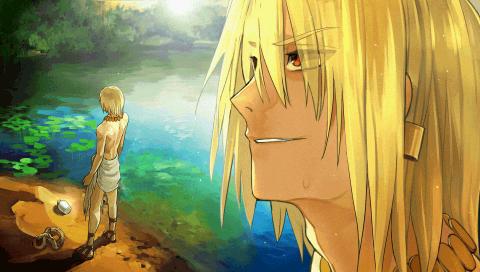
- One of Gilgamesh's achievements was the construction of the city walls of Uruk to defend his people from enemies.
- Gilgamesh designed and beautifully remodeled the ancient Sumerian city of Uruk.
- Uruk's flourishment speaks for itself.
- His departure from gods (despite his mother being a goddess) enabled humanity to stand on its own feet. This feat alone qualifies him as Best King in my standard.
- He protected humanity against superthreats like Humbaba.
- His wish to escape human limitations, to get answers to questions not available to his contemporaries and to overcome mortality.
- He proclaims the worldwide glory of "He Who Saw the Deep", who shall be remembered for his wisdom, who disclosed a secret and who brought back reports of what had been before the Deluge.
- His path was long and difficult, a road less traveled, a way of many trials and tribulations. He nevertheless completed the journey and became wiser than any on Earth, and he engraved what he had learnt on a stela for the sake of posterity.
- He's a true renaissance man who embraced humanity advancements. For example, the future he wants to for humanity is one in which we'll emigrate to other planets and explore the universe, which is pretty awesome! Tell me how many modern leaders even have this on their mind?!
This character has so much depth and complexity that I can't put all into words. Easily 1 of the top 3 in the Fate franchise. I take Fate/Zero Gilgamesh as canon and much closer to the complexity of his legend. Urobuchi says that he tried his best to give more dimensions to Gilgamesh but "didn't quite succeed" because he had to keep his character somewhat close to FSN. In my eyes, he has succeeded, since Fate/Zero characterization of him has set the precedent for his subsequent installments in CCC and Babylonia.
These other instances illustrate the reasons why I came to appreciate this character:
Banquet of Kings scene - see this entry for my take on this brilliant scene.
Then:
Kirei talk with Gilgamesh (part 1)
Kirei talk with Gilgamesh (part 2)
This scene shows how Gilgamesh is not only a fighter or an experienced king, but a man. He has seen much of what the world has to offer and learned much in the process. According to him, one should seek pleasure instead of drowning in hypocrisy. I can’t really put it any better: This scene shows the audience how wise Gilgamesh is! (when his ego isn't talking). He taught Kirei to question doctrines. He didn't mind what Kirei chose, as long as it's his own choice. [ Not sure if I agree with the "do whatever you want as long as it pleases you" line of thought - it makes me THINK -- this is why Fate/Zero is brilliant! ]. Gilgamesh likes it when people are honest. He is also self-aware. As an example, you can totally say he's a tyrant and an asshole to his face and he will laugh and praise your honesty (eg, Andersen, in contrast to the pretentious majority on this planet who would 100% get mad if you told them they were fat/short/thot/etc). Everyone whom he has taken a liking to are those who never kiss up to him. He likes Kirei, Iskandar and in a terrible way, he "likes" Saber as well. There are 3 characters in the series that Gil uses the more friendly "omae" for: Enkidu, Kirei and sometimes Saber. Iskandar, he calls "sonata" which is very respectful and he only uses it for him. None of these people ever had to work to make him like them. In fact, Kirei spends most of F/Z trying to ignore and insult him. Despite this, Gil is barely ever rude to him and only threatens him once: he says if he ever tires of Kirei, he'll kill him, but considering they spend the next decade together, it just enforces how much he likes him.
"'All the evils in the world'? Bring thrice as much if you want to taint me!"
How Gilgamesh overcame All the World's Evil when he was bathed in the Grail's mud in Fate/Zero (excerpt from the Light Novel):
—A vortex started up. Sin, the evil in this world, circulated and multiplied and chained and changed as it whirled into a vortex. Gluttony lust greed depression wrath sloth hypocrisy pride envy, over and over again encroaching and sprouting, whirling into the vortex.
The crime of rebellion, the crime of intimidation, the crime of adultery, the crime of destruction, the seven cardinal sins, the crime of coercion, .............. all crimes should be assessed and sentenced to capital punishment or severe punishment. Refuse and deny all hatred. Kill kill kill. It is absolutely forbidden. Kill kill kill. He will absolutely not agree. Ah it is really boring to have only this one thought—
“—!?”
The vortex of sound that was the curse now circled. There existed something here that should not exist; from within the barrage of denying curses, a voice cried out,
"Yes!"
Impossible. Affirmations and correctness did not exist within this cursed vortex of hatred. Because everything had determined that everything was ugly and hateful, this word could not appear here—But that voice announced again clearly,
“That is right.”
That is right. The world was originally already like this. Since the truth has been put before your eyes, why do you sigh? Why are you surprised?
“—!?”
The voice of the curse asked, "What was right? Who was there to acknowledge it? Who was there to permit it? And who was to bear the burden of sin?"
Facing the bombshell tossed from the darkness—in reply, a resounding and concrete sneer: "A foolish question. That goes without asking. The King will acknowledge it; the King will permit it. The King will bear the burden of the entire world."
“—!?”
The mud asked, "What is a king?" But at the same time it asked the question, it realized it had contradicted itself. In this place that strictly did not allow the existence of entities, the mud had admitted that there was someone else within it. Some strange foreign object that could not exist had appeared here. That was—King—the presence of an absolute controller, as well as one without equal.
"His name was—King of Heroes, Gilgamesh."
“That is I!”
The black mud cracked and dispersed away, leaving flying droplets. The foreign object it could not digest even by mobilizing all its hatred appeared from within the black mud. Within the burning ruins, he once again stood upon the ground. The perfect, golden-proportioned body was no longer the spirit form that it had taken during its time as a Servant, but a true flesh body. The black mud that denied all life crystallized the impurity within itself and then abandoned it, with the result that a certain Heroic Spirit had realized his wish of obtaining a corporeal body and returning to this world.
Even standing right amid a burning hell, the majesty emanating from the body of the king made the surrounding flames afraid to come close. Gilgamesh generously bared his naked statue-like body, sneering impatiently.
Even though he felt it to be very troublesome, he could not refuse to meet battle since this was the challenge issued to him by the gods. Gilgamesh began to laugh wryly again at his status as the King of Heroes.
Also, Kirei's revival:
"The black mud which had been unable to corrupt Archer followed the path of the mana supply that had formerly linked Archer to his Master, arrived at Kotomine Kirei’s physical body and became the source of a life-force supply that substituted for a heart". Thus had Kirei revived.
Why did the mud spit Gilgamesh back out? Because the Grail could not corrupt him even after utilizing all of its hatred. Servants are normally corrupted upon contact with the Grail, but Gilgamesh is incorruptible due to his powerful ego that can stave back the mental pollution. The anime makes it look like "being spit out of the mud" was no big deal, but this is one scene I hate Ufotable for leaving out. It's one of the reasons Gilgamesh is the most badass King - who else but he could emerge from that, even better than before?
"I have been bearing the burden of humanity from the beginning of time". He doesn't "break" under such burden and we all know that he will never "break". Other instances that demonstrate his strength were when his only friend died and then when his search for immortality failed, he turned pain into character growth. I like how he can stand up to everything. Strength of mind, strength of body, courage and intellect - Is there anyone else more fitting to be a King of All?
Babylonia Arc - Grand Order
Addendum:
- The view on Immortality in Fate (concerning Gilgamesh)
- In Fate/Strange Fake, Gilgamesh acts as a mentor to his little Master, telling her that "children eyes should be shining with potentials and wonders" because he sees through it that the adults are using her as a figurehead, so he tells her to follow her own path, and shows her that is more in life than duty and sacrifice. One look at this tells me that Fate/Strange Fake intends to do the Sesshomaru-Rin moe-moe relationship type with Gilgamesh-Tine :P
- In Fate/Extra CCC, Gilgamesh learns to like Hakuno; although he scolds him from time to time, he dispenses wisdom along the way and saves his life by breaking the rule at the end.
- In Fate/Extella, Gilgamesh offers himself as "second in command", pretending it's to honor his father's promise when he's just there to watch out for Hakuno.
- Even in Fate/Zero, he's nice to Iskandar and Kirei, offers a bit of wisdom to Saber (by telling her she's not wrong and to continue on her path), and spares Waver out of admiration for his loyalty (while other Masters don't spare each other).
- Gilgamesh subreddit :D
[ To be updated ]
30 December 2018
My view on Saber's kingship
I don't disagree with Saber's idea of kingship. I even think that it's ok to have regrets. But I disagree with her wish to go back and redo things, only because her people - the Anglo Saxons - had been pushed out by other tribes.
Her view is the unrealistic and naive view.
Britain nowadays is quite successful. [ Success = measured by Human Development Index, GDP per capita, scientific-technological advancements, competent non-oppressive government ].
It shouldn't matter who is leading Britain, as long as it is a prosperous and one of the best countries nowadays.
The struggles between ethnic groups have always been stupid to no end because none has the vision to realize that they are all citizens of planet Earth. Yes, there was oppression and failure of some individual groups but the end-result turns out good (as opposed to the communist and sharia countries that are experiencing the bad result of the "wrong groups" winning). For Britain, does it mean that the losers should go back and rewrite the past just for the sake of being in control? Fuck no.
Too bad her people were pushed out. But what comes? The future isn't worse because of it.
"I want to return Britain to glory."
"Britain is already glorious. What are you talking about?" When something is working, don't change it.
Saber is short-sighted for being fixated on the past instead of the present. She failed to see that a kingdom divided against itself (feuding among the Knights of the Round Table) would inevitably fall or even that a perfectly united kingdom could never exist in the first place.
The time to try was in the past. Now wishing to undo the prosperous present to save the past is a personal wish, because the future could change for the worse and she doesn't think or care about that. The only time when it's ever ok to redo is when the present is doing so badly due to a particular past event and if you could go back to the turning point to change it (like what Chaldea does).
Did Saber ask whether her people and today's people would want to redo anything - even if it wouldn't change the entire world's history? She was the people's chosen king. Would they be happy with someone else? This is the point that Iskandar brought up: it would be an insult to the people in both past and present to redo especially when the present is doing well.
This is not just her people but humanity's advancement as a whole. Does Saber care about how her wish - if it came to fruition - would change the future? She cares about HER people but does she care about humanity as a whole and where it's heading? Is WHO is leading more important than WHAT they can do? Is this group superiority thinking?
This whole thing proves that her kingship belonged in the past and should not be meddling with the present day because she doesn't have a future vision.
Her view is the unrealistic and naive view.
Britain nowadays is quite successful. [ Success = measured by Human Development Index, GDP per capita, scientific-technological advancements, competent non-oppressive government ].
It shouldn't matter who is leading Britain, as long as it is a prosperous and one of the best countries nowadays.
The struggles between ethnic groups have always been stupid to no end because none has the vision to realize that they are all citizens of planet Earth. Yes, there was oppression and failure of some individual groups but the end-result turns out good (as opposed to the communist and sharia countries that are experiencing the bad result of the "wrong groups" winning). For Britain, does it mean that the losers should go back and rewrite the past just for the sake of being in control? Fuck no.
- Because the present isn't a failure in any sense.
- Doing that would change entire world's history.
- In case of Saber, she doesn't ask if today's humans would want a different leader.
- There's no guarantee that the future they would bring would be as good as it is today.
Too bad her people were pushed out. But what comes? The future isn't worse because of it.
"I want to return Britain to glory."
"Britain is already glorious. What are you talking about?" When something is working, don't change it.
Saber is short-sighted for being fixated on the past instead of the present. She failed to see that a kingdom divided against itself (feuding among the Knights of the Round Table) would inevitably fall or even that a perfectly united kingdom could never exist in the first place.
The time to try was in the past. Now wishing to undo the prosperous present to save the past is a personal wish, because the future could change for the worse and she doesn't think or care about that. The only time when it's ever ok to redo is when the present is doing so badly due to a particular past event and if you could go back to the turning point to change it (like what Chaldea does).
Did Saber ask whether her people and today's people would want to redo anything - even if it wouldn't change the entire world's history? She was the people's chosen king. Would they be happy with someone else? This is the point that Iskandar brought up: it would be an insult to the people in both past and present to redo especially when the present is doing well.
This is not just her people but humanity's advancement as a whole. Does Saber care about how her wish - if it came to fruition - would change the future? She cares about HER people but does she care about humanity as a whole and where it's heading? Is WHO is leading more important than WHAT they can do? Is this group superiority thinking?
This whole thing proves that her kingship belonged in the past and should not be meddling with the present day because she doesn't have a future vision.
27 December 2018
Fate/Zero: Kings' Banquet (and how Gilgamesh sees Saber)
This scene is brilliant!
The way each of the 3 kings define "King" is different.
But even when that is the case, they can accept the belief of certain views, but not others.
The 2 Kings before Saber make their thoughts clear to her.
No beating around the bush.
Also, Iskandar and Gilgamesh are just so badass.
Their rivalry and respect for each other is one of the highlights of the Servants in Fate/Zero.
Now let's go the meaning of the scene - this is how I understand it:
Gilgamesh's position is that he can do whatever he wants because he's got the power to do it.
Iskandar's position is that the king should be a relatable figure, which means being things like being greedy, holding one's head up high, being a leader figure, in order to win the hearts and minds of his subjects and unify them under those common terms. Ionioi Hetairoi is walking proof that this method worked.
Saber, on the other hand, holds the view of being good will result in good things. But she was good and her kingdom fell apart anyway. She thinks she was wrong somewhere along the way, regrets and wants to do it over again. My view on Saber's kingship.
Iskandar scolds her on how she's ignoring the reality in favor of her pretty ideals and that's why her people couldn't get on her level. Gilgamesh finds her naivety amusing.
Iskandar dislikes how Saber regrets her kingship, and the burden she takes on as king, in his view, isn't how kingship should be. Wanting to erase everything by choosing someone else is an insult to the people who followed her to the very end since in his opinion, the King must believe in himself. So even if she pointed out to him how he had failed in his life, the point would still stand that regret isn't a thing to him.
How Gilgamesh sees Saber:
The whole scene makes it look like the only right one is Iskandar. But: Gilgamesh's viewpoint isn't as simple as mocking Saber's ideal because he thinks it's wrong:
I believe him to be, on the spectrum of Iskandar to Arthuria, is closer to the latter. While in his youth he was tyrannical, later after he returned from his adventure, he was a wise and just king who ruled alone, by the law, for the people, and at the end died from overworking for his kingdom! Speaking from experience, he sees a "little girl" attempting to take on the responsibilities of kingship as ridiculous. To his eyes, her ideals and way of life are doomed to fail, yet she continues to fight against that inevitability. It's a stubbornness and idealism that he rarely sees, and he wants to see her struggle to attain the unattainable because of how amusing it will be. The way Gilgamesh sees her also has a touch of admiration because Gil always likes it when a human dares to reach for impossible goals (that's why he acknowledges her kingship and tells her that there's no right or wrong answer and that she should keep going on her path - see the Novel's excerpt below). At the same time, he finds her struggle amusing because it is futile, and in his twisted way, he tries to break her to see how strongly her conviction would hold up against him.
The difference between Gilgamesh and Arthuria lies in the fact that Arthuria let her role as a King consume her and turn her into something almost devoid of any joy and life, while King Gilgamesh wielded that title with pride, giving respect to his subjects and demanding it in return. He was not consumed but living at his fullest the joys and hardships of being King, while Arthuria regretted becoming one. Unlike Arthuria whose kingship is more of a one-sided love which withered and died at the end, Gilgamesh sacrificed a lot for his people but in his mind, he always believes that if the king met his demise, the people in Uruk would suffer greatly! So he stayed alive for the sake of his people. Gilgamesh was a happy King and regretted nothing.
Fate/Zero Novel Volume 3, Act 10, -84:19:03
– Once upon a time, there was a man. He was a foolish and ridiculous fellow whom, despite having a body made of mud and soil, set his heart to stand shoulder to shoulder with gods.
Even to this day, the King of Heroes still couldn’t forget the way that he passed away with tears streaming down his face. ................. Like so, when he saw that man taking his last breath, the incomparable king realized – the way that this man, who was human but wanted to surpass humanity, had lived, was even more precious and more brilliant than all the treasures he had collected.
“You fool who stretch your hand towards realms not of men… There is only one person in heaven or earth who’s worthy of appreciating your destruction, and that is none other than I, Gilgamesh.
Sink into my embrace, oh you glorious and illusionary men. That is my decision.”
The golden majestic brilliance disappeared in the night mist, leaving only an evil laughter echoing long after.Fate/Zero volume 4, final battle:
"I don’t know why you are so obsessed with some wish-granting Grail. Saber… the fact that a woman like you exists can already be considered a rare miracle, no?”( So... the way Gilgamesh appreciates Saber is the same way he appreciated his friend Enkidu. I never thought there was some genuine admiration in his "Saber obsession" until I've seen Fate/Zero.
Archer’s tone was unnaturally calm, as if it was not a dangerous enemy that was before him.
"Abandon these pointless ideals and vows! These things will only restrict you and bring you misfortune. In the future, you'll need only desire me and live under my protection. In that case I vow, on my honor as King of Everything, that I will grant you all the happiness in the world."
Gilgamesh wants to see exceptional things, especially people who are trying to do impossible things and have the abilities to come very close to obtaining these dreams, those who defy gods/destiny, those who never give up no matter what. Enkidu, Saber, Hakuno happened to have one of the traits that Gil admires in humans.
To Gilgamesh who believes that seeking pleasure is the proof of one's humanity, seeing Saber actively avoid seeking her own happiness is quite unsettling and fascinating to him. The difference is that, unlike in his interaction with Kirei, he doesn't let Saber make her own decision.
Saber is someone who, in Iskandar's words, "discarded youthful romance and dreams, discarded love, and sunk into the eternal curse of ideals". Because of the way Arthuria was raised, she became "inhuman" since she discarded all her emotions; that's part of the reason Gilgamesh and Iskandar made fun of her, especially Gilgamesh seeing having desires is part of being humans so he probably sees her as a challenge to make her feel something other than regret towards her failures in life. Very very few men, if any, would be interested in a woman who didn't even have love/marriage on her list of priorities. Only Gilgamesh appreciates a woman like that. I would go for women like that, too, as oppose to those who have little dreams/ambitions and only speak the language of "romance".
Note that I'm not trying to romanticize the whole thing. Gilgamesh never truly loves Saber and is quite disrespectful toward her. The irony is that should Saber ever lose sight of her ideal, he will drop her instantly.
In all of that, it's this admiration he has for her and this part alone seems genuine. I give credit where it deserves ).
21 December 2018
Immortality is fantastic!
I believe immortality is a wonderful thing and that all of the reasons for it being bad are just not strong enough to convince me otherwise.
I get that living forever can seem scary; the unknown is. But that is just individual perceptions of immortality. This is not what humanity as a whole agrees upon. People who don't want to live forever or only want to live to a certain age can just kill themselves when they are tired of living.
Earth's overpopulation would be the only problem to worry about on a large scale. But with more time to tackle this issue, we can keep working on them. I don't know the solutions yet - maybe we'll live on Mars - but that's the whole excitement of living to see the ever-changing future: We can keep trying things and learning and pushing for improvement. Imagine what great achievements would come about if humanity's greatest minds (eg, Newton, Einstein, Tesla, etc) were given immortality?
I don't agree with the argument that "without death, humans can't grow". Where did people get the idea that the longer life is, the less meaningful it becomes? Why do some people seem so adamant that continuing on and foregoing the mental and physical degradation we currently deem acceptable is such a bad thing? Remember that humans nowadays can and have the conditions to achieve far more than we ever did because the we don't have to struggle for most basic necessities like ancient humans did. Being freed from bothering about those kinds of inconveniences, we have been able to concentrate on enriching our minds.
In 1900, the average human lifespan was 47 years. By 2000, they lived to 76. Are middle-aged people today wishing they could speed through the next few decades and get them over with? Do those pushing 100 feel like they've been dealt a bad hand?
Not-dying is what we strive for with medical advances, after all. And if you don't think we should continue striving to live as long as possible, where's your cut-off line? Reaching a point where we can live for as long as we want seems like a pretty natural conclusion. Immortality doesn't seem like such a big dream.
The "no progress" argument assumes that death is the only struggle humans do/will ever face in life. This is immortality, not invincibility. There will always be new challenges, new horizons to reach, eg, will we be able to become an interstellar species?
05 June 2009
Gestalt Prayer
"I am I.
You are you.
I do my thing and you do your thing.
I am not in this world to live up to your expectations,
And you are not in this world to live up to mine.
You are you, and I am I,
And if by chance we find each other, it's beautiful.
If not, it can't be helped."
*
私 は 私。
あなた は あなた。
私 は 私 の ために 生き
あなた は あなた の ために 生きる。
私 は あなた の 期待に 応える ために この世に 生きてる わけじゃない。
そして、あなた も 私 の 期待に 応える ために この世に 生きてる わけじゃない。
あなた は あなた、私 は 私。
もしふたり が 出会えれば それは 素晴らしい こと
出会えないくても それは やむをえない ことだ。
-- by psychotherapist Fritz Perls
1969
Subscribe to:
Posts (Atom)
