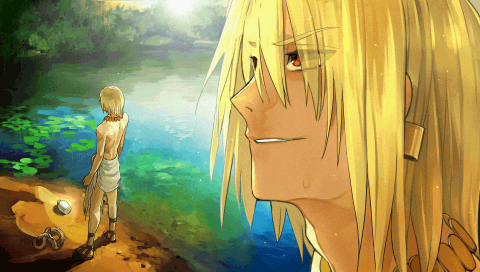
Gilgamesh is a character that I went from dislike to like as I went through the
Fate series. I initially disliked him when I got into FATE starting with
Unlimited Blade Works and
Fate 2006. Then I realized that Gilgamesh
FSN version is just where the author (Nasu) inserted a quick villain to be an "anti-Shirou" device, no more and no less - anyone could fill that role - whereas his character is very well-developed in is character is very well-developed in
Fate/Zero (by Urobuchi) and subsequent works where we can see his reasoning, his legend (which is one of the coolest) and his dynamics with other characters. Even his interest in Arthuria in
Fate/Zero has some basis in ideologies rather than FSN's "yo, I'm just here to be the MC's love rival".
If I have to say anything about Gilgamesh, it's that he's defiantly got a personality. His backstory and complexity fascinate me despite the fact that I don't normally like arrogant people. Gilgamesh in his younger years was never "good" in a Disney sense, but not evil, either.
An interesting "grey" character is much better than a boring hero.
The Epic of Gilgamesh is the earliest hero story of mankind where the MC has more character development than most fictions nowadays.
Fate/Zero is just a glimpse into that. There are also
F/E CCC,
Extella and
Babylonia, which together give us a complete picture of who he is.
Guardian of Humanity
All of Gilgamesh versions would die for humanity.
"At first I acknowledged the gods and protected humans. When my childhood ended, I hated the gods and favored humans."
Born from a goddess and a human king, Gilgamesh was created by the gods to connect humanity closer to them. However, he dislikes past kings because they were god-fearing weaklings in his eyes, and he chose to depart from the gods so that humanity could thrive. And his rule, with him rejecting the gods, began the
Age of Mankind!
 The protection of gods is no longer needed in the world of man. As proof, I built a fortress, and you all answered my call. I know now, with certainty, that it was no mistake! And now this final trial will test it, and us, to the utmost.
Now is the time to deny the primordial gods and begin the Age of Man! Mind yourselves, my elite warriors! This is the battle for true separation from the gods! Give your lives to me, the king! Pass on the glory that is Uruk to generations to come, to the last man!
~ Gilgamesh's declaration to Uruk as Tiamat approaches
In
UBW, Gilgamesh wasn't trying to destroy humanity; he's trying to save it. He's willing to make himself a villain as long as it means humanity's improvement in the long term. While he floated through the Grail's mud at the end of
Fate/Zero, it showed him visions of all of humanity's worst moments. Gilgamesh loves humanity's potential and was already expecting us to expand to the stars in his vision but he found that we grew complacent instead. For he who thinks lives are worthy only if they strive to live their hardest, seeing modern humans' complacency compared to the people in his kingdom (which is described in Babylonia where people remained steadfast and unbroken before the daily assaults of deities) made him feel disgusted. And being given a physical body by the Grail, Gilgamesh felt that he had the responsibility to steer humanity's path.
I think that his thinking was, to some extent, correct: comparing Babylon in ~2600BC vs. the Middle East today, and ancient Egypt vs. today's Egypt,... I can't help but wondering: After
thousands of years, humanity should be
much much better than that, right...? As another fan pointed out: "Gilgamesh's end-goal of 'purging' through Angra Mainyu (aka: All the World's Evil) was "fair" from his point of view: It's 6 billion humans vs. 6 billion evils born from themselves. And it made sense to him that humanity should be able to defeat its own evils". So he tried to fix it by kick-starting a Darwinism process with himself as our immortal leader to guide us - though his method in
UBW was bad. But then, being an "Ally of Justice" doesn't mean being chivalrous or altruistic. Like EMIYA who has to do a lot of killings as a Counter Guardian to 'save' humanity, what Gilgamesh tried to do is what Counter Guardians do on a larger scale.
While Gilgamesh does not like individual humans, he loves humanity as a whole. Like Merlin, he doesn't like individual humans but the stories, the legacy, the achievement of humanity. He works his people very hard because he thinks that lives are worthy only if they strive to live to the fullest. He challenged people to grow because he thought protection could make them complacent and stagnant. I do not agree with this line of thinking. (But as we can see in
F/E CCC, he enjoyed pushing Hakuno because he wanted "to see the story of the human Hakuno"). At the same time when people were threatened by something huge (eg, Humbaba, Altera, the Shadow, Tiamat,...), he went to fight them to protect humans.
An Epic Journey
Coming face-to-face with his own mortality set him on a quest for immortality, only to fail to gain it and eventually, he accepted that he would someday die. To Gilgamesh, it's more than the fear of death itself: "The despair that he felt was because he saw death as an end of his duty as the observer of humanity: in order to fulfill his mission completely, he wanted to observe humanity's path until its very end."

Gilgamesh wanted to escape human limitations, to get answers to questions not available to his contemporaries, and most importantly, he wanted to overcome mortality both for himself and mankind. At the end, he came to term with his limitations as a human. This completed his journey, achieving the final crucial step: By pushing himself past disappointment and grief and focusing on the needs of his people, Gilgamesh triumphed and became a nobler sort of hero. Is he a role model? No. But he can serve as a symbol for an aspect of humanity, of growing past mistakes and accepting limitations. In the end, Gilgamesh is considered a hero not just for his incredible deeds but for
coming to understand and accept his true nature.
- One of Gilgamesh's achievements was the construction of the city walls of Uruk to defend his people from enemies.
- Gilgamesh designed and beautifully remodeled the ancient Sumerian city of Uruk.
- Uruk's flourishment speaks for itself.
- His departure from gods (despite his mother being a goddess) enabled humanity to stand on its own feet. This feat alone qualifies him as Best King in my standard.
- He protected humanity against superthreats like Humbaba.
- His wish to escape human limitations, to get answers to questions not available to his contemporaries and to overcome mortality.
- He proclaims the worldwide glory of "He Who Saw the Deep", who shall be remembered for his wisdom, who disclosed a secret and who brought back reports of what had been before the Deluge.
- His path was long and difficult, a road less traveled, a way of many trials and tribulations. He nevertheless completed the journey and became wiser than any on Earth, and he engraved what he had learnt on a stela for the sake of posterity.
- He's a true renaissance man who embraced humanity advancements. For example, the future he wants to for humanity is one in which we'll emigrate to other planets and explore the universe, which is pretty awesome! Tell me how many modern leaders even have this on their mind?!
Gilgamesh wants to see exceptional things, especially people who are trying to do impossible things and have the abilities to come very close to obtaining these dreams, those who defy gods/destiny, those who never give up no matter what.
This character has so much depth and complexity that I can't put all into words. Easily 1 of the top 3 in the
Fate franchise. I take
Fate/Zero Gilgamesh as canon and much closer to the complexity of his legend. Urobuchi says that he tried his best to give more dimensions to Gilgamesh but "didn't quite succeed" because he had to keep his character somewhat close to
FSN. In my eyes, he has succeeded, since
Fate/Zero characterization of him has set the precedent for his subsequent installments in CCC and Babylonia.
These other instances illustrate the reasons why I came to appreciate this character:
Banquet of Kings scene - see this entry for my take on this brilliant scene.
Then:
Kirei talk with Gilgamesh (part 1)
Kirei talk with Gilgamesh (part 2)

Kirei's talks with Gilgamesh felt like therapy sessions for Kirei. Gilgamesh's read on humans is remarkable. As a little example, he could instantly tell when Kirei deliberately withheld information and lied to him. Kirei was an enigma, even to himself, and that fascinated Gilgamesh. Kirei was selected by the Grail because he had a wish worthy of it, yet he did not even know what that wish was. He did not even know what pleasure was, and just blindly believed it to be a sin as decreed by his religious faith. He was a man who was unlike others yet performed outside of his nature for he was instructed to do so. Gilgamesh had quite the plaything in front of him to try to unwrap and enlighten. By having Kirei undertake the exercise of learning the wishes of the other Masters, Gilgamesh was able to pick up on what Kirei unconsciously was drawn to the most: the plight that Kariya Matou was suffering in his "foolhardy" attempt to save Sakura. (If you paid attention closely when Kirei was talking about Kariya, you see that he smiled for the first time in the series). As Gil pointed out to him, 'it is possible to find pleasure in suffering and tragedy'. Kirei quickly rejected the thought as inhumane and a sin, and thus something he, as a member of the Church, should reject. Yet the Grail granted him new Command Seals. Thus, with the aid of Gilgamesh's prodding, started the path of Kirei finding his own (albeit twisted) happiness, freed from being Tokiomi's minion...
This scene shows how Gilgamesh is not only a fighter or an experienced king, but a man. He has seen much of what the world has to offer and learned much in the process. According to him, one should seek pleasure instead of drowning in hypocrisy. I can’t really put it any better: This scene shows the audience how wise Gilgamesh is! (when his ego isn't talking). He taught Kirei to question doctrines. He didn't mind what Kirei chose, as long as it's his own choice. [ Not sure if I agree with the "do whatever you want as long as it pleases you" line of thought - it makes me THINK -- this is why
Fate/Zero is brilliant! ].
Gilgamesh likes it when people are honest. He is also self-aware. As an example, you can totally say he's a tyrant and an asshole to his face and he will laugh and praise your honesty (eg,
Andersen, in contrast to the pretentious majority on this planet who would 100% get mad if you told them they were fat/short/thot/etc).
Everyone whom he has taken a liking to are those who never kiss up to him. He likes Kirei, Iskandar and in a terrible way, he "likes" Saber as well. There are 3 characters in the series that Gil uses the more friendly "omae" for: Enkidu, Kirei and sometimes Saber. Iskandar, he calls "sonata" which is very respectful and he only uses it for him. None of these people ever had to work to make him like them. In fact, Kirei spends most of F/Z trying to ignore and insult him. Despite this, Gil is barely ever rude to him and only threatens him once: he says if he ever tires of Kirei, he'll kill him, but considering they spend the next decade together, it just enforces how much he likes him.
"'All the evils in the world'? Bring thrice as much if you want to taint me!"
How Gilgamesh overcame All the World's Evil when he was bathed in the Grail's mud in Fate/Zero (excerpt from the Light Novel):
—A vortex started up. Sin, the evil in this world, circulated and multiplied and chained and changed as it whirled into a vortex. Gluttony lust greed depression wrath sloth hypocrisy pride envy, over and over again encroaching and sprouting, whirling into the vortex.
The crime of rebellion, the crime of intimidation, the crime of adultery, the crime of destruction, the seven cardinal sins, the crime of coercion, .............. all crimes should be assessed and sentenced to capital punishment or severe punishment. Refuse and deny all hatred. Kill kill kill. It is absolutely forbidden. Kill kill kill. He will absolutely not agree. Ah it is really boring to have only this one thought—
“—!?”
The vortex of sound that was the curse now circled. There existed something here that should not exist; from within the barrage of denying curses, a voice cried out,
"Yes!"
Impossible. Affirmations and correctness did not exist within this cursed vortex of hatred. Because everything had determined that everything was ugly and hateful, this word could not appear here—But that voice announced again clearly,
“That is right.”
That is right. The world was originally already like this. Since the truth has been put before your eyes, why do you sigh? Why are you surprised?
“—!?”
The voice of the curse asked, "What was right? Who was there to acknowledge it? Who was there to permit it? And who was to bear the burden of sin?"
Facing the bombshell tossed from the darkness—in reply, a resounding and concrete sneer: "A foolish question. That goes without asking. The King will acknowledge it; the King will permit it. The King will bear the burden of the entire world."
“—!?”
The mud asked, "What is a king?" But at the same time it asked the question, it realized it had contradicted itself. In this place that strictly did not allow the existence of entities, the mud had admitted that there was someone else within it. Some strange foreign object that could not exist had appeared here. That was—King—the presence of an absolute controller, as well as one without equal.
"His name was—King of Heroes, Gilgamesh."
“That is I!”
The black mud cracked and dispersed away, leaving flying droplets. The foreign object it could not digest even by mobilizing all its hatred appeared from within the black mud. Within the burning ruins, he once again stood upon the ground. The perfect, golden-proportioned body was no longer the spirit form that it had taken during its time as a Servant, but a true flesh body. The black mud that denied all life crystallized the impurity within itself and then abandoned it, with the result that a certain Heroic Spirit had realized his wish of obtaining a corporeal body and returning to this world.
Even standing right amid a burning hell, the majesty emanating from the body of the king made the surrounding flames afraid to come close. Gilgamesh generously bared his naked statue-like body, sneering impatiently.
Even though he felt it to be very troublesome, he could not refuse to meet battle since this was the challenge issued to him by the gods. Gilgamesh began to laugh wryly again at his status as the King of Heroes.
Also,
Kirei's revival:
"The black mud which had been unable to corrupt Archer followed the path of the mana supply that had formerly linked Archer to his Master, arrived at Kotomine Kirei’s physical body and became the source of a life-force supply that substituted for a heart". Thus had Kirei revived.
Why did the mud spit Gilgamesh back out? Because the Grail could not corrupt him even after utilizing all of its hatred. Servants are normally corrupted upon contact with the Grail, but Gilgamesh is incorruptible due to his powerful ego that can stave back the mental pollution. The anime makes it look like "being spit out of the mud" was no big deal, but this is one scene I hate Ufotable for leaving out. It's one of the reasons Gilgamesh is the most badass King - who else but he could emerge from that, even better than before?
"I have been bearing the burden of humanity from the beginning of time". He doesn't "break" under such burden and we all know that he will never "break". Other instances that demonstrate his strength were when his only friend died and then when his search for immortality failed, he turned pain into character growth. I like how he can stand up to everything. Strength of mind, strength of body, courage and intellect - Is there anyone else more fitting to be a King of All?
Babylonia Arc - Grand Order
It is here that Gilgamesh's good qualities really shine: He fully commits to the betterment of his kingdom and genuinely cares for his subjects. In turn, he is rewarded with their loyalty and love even in the face of destruction. He also shows a better degree of patience and tolerance when first meeting Gudao and co., testing their value by having them first perform menial tasks. Also, his interaction with Ishtarin makes for comedy gold! This
Gilgamesh here is
Fate/Zero Gilgamesh who is tempered and wise - the older version of him after he returned from his long quest for immortality - and rules over Uruk with more wisdom. He no longer considers Ea his greatest treasure, but the people of Uruk themselves (he gave away most weapons in his treasury to his people). This Gilgamesh is the one who has reached the depth of mankind's wisdom and has returned to instruct mankind. However, it's not a 180° change of character - he still retains a lot of arrogance. [ I actually like that it isn't a complete 180° change because that wouldn't be interesting anymore - especially when he brings comedy to many scenes that he's in ]. In short, older Gilgamesh is
"He Who Saw the Deep", he who leads the present to the future.
Addendum:
- The view on Immortality in Fate (concerning Gilgamesh)
- In Fate/Strange Fake, Gilgamesh acts as a mentor to his little Master, telling her that "children eyes should be shining with potentials and wonders" because he sees through it that the adults are using her as a figurehead, so he tells her to follow her own path, and shows her that is more in life than duty and sacrifice. One look at this tells me that Fate/Strange Fake intends to do the Sesshomaru-Rin moe-moe relationship type with Gilgamesh-Tine :P
- In Fate/Extra CCC, Gilgamesh learns to like Hakuno; although he scolds him from time to time, he dispenses wisdom along the way and saves his life by breaking the rule at the end.
- In Fate/Extella, Gilgamesh offers himself as "second in command", pretending it's to honor his father's promise when he's just there to watch out for Hakuno.
- Even in Fate/Zero, he's nice to Iskandar and Kirei, offers a bit of wisdom to Saber (by telling her she's not wrong and to continue on her path), and spares Waver out of admiration for his loyalty (while other Masters don't spare each other).
- Gilgamesh subreddit :D
[ To be updated ]